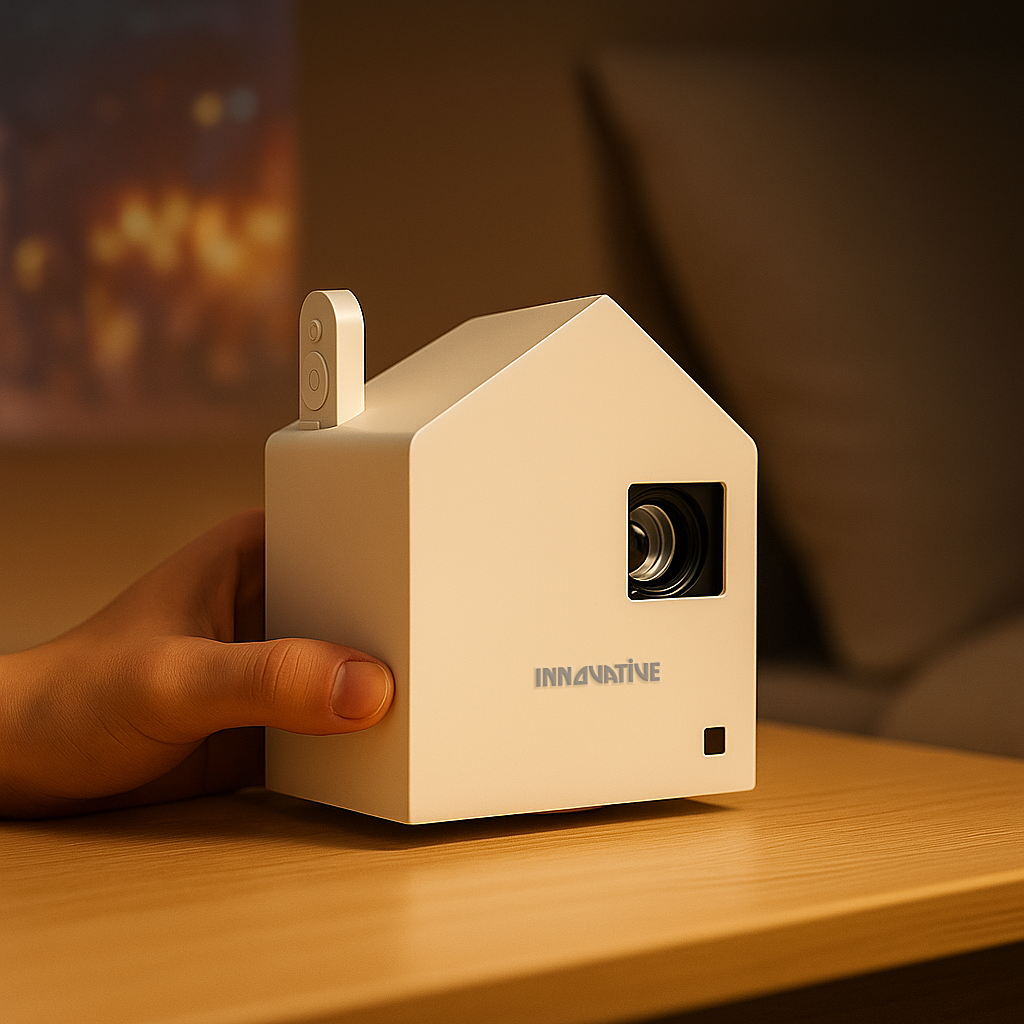

A projector for room to room use should make a big screen easier to enjoy, not give you another device to troubleshoot. The real test is simple: can you move it from a bedroom movie night to the living room, then set it up again in minutes without sacrificing a watchable image? That takes more than a compact shell and a carry handle.
Cheap portable projectors often promise cinema anywhere, then reveal the catch: weak real brightness, poor focus around the edges, tinny sound, laggy wireless streaming, or a battery that lasts less than a movie. Room-to-room projection can be wonderfully flexible, but only when the projector is selected for the rooms you actually use.
What Makes a Projector Truly Easy to Move?
Portability is not just about weight. A projector that weighs a few pounds is convenient only if it also starts quickly, finds a level image, connects reliably, and works from more than one location. The goal is freedom from permanent installation, not a new ritual of adjusting cables and menus every time you change rooms.
Look for a practical combination of compact size, built-in streaming or dependable wireless casting, and quick image correction. Autofocus and automatic keystone adjustment are especially useful when the projector will sit on a dresser one night and a coffee table the next. They are convenience features, not substitutes for good placement, but they remove much of the friction from casual use.
A built-in battery can make room-to-room use even simpler. It lets you watch without hunting for an outlet and keeps cords away from high-traffic areas, children, and pets. Battery power does involve a trade-off, though. Battery-capable projectors are often smaller and less bright than models designed to stay plugged in. For a dark bedroom, that can be ideal. For a sunlit family room, a plugged-in projector with higher real brightness may be the better call.
Projector for Room to Room Use: Start With Light
Brightness is where marketplace listings become least trustworthy. Many low-cost models advertise enormous lumen numbers that do not reflect a meaningful, standardized measure of visible brightness. A giant claim on a product page does not guarantee a clear daytime image. Real-world testing matters far more than a number chosen to win a search result.
For evening viewing in a bedroom or den with lights dimmed, a portable projector can create a satisfying image without extreme output. If you want to watch sports in the living room with blinds open, lights on, or sunlight hitting the wall, you need substantially more brightness and a better projection surface. No projector defeats direct sunlight. That is physics, not a setting hidden in the menu.
Think about your brightest intended room, not only your favorite dark one. If the projector will move between a controlled bedroom and a bright common room, choose for the harder environment or accept that your viewing habits will change by room. In the darker room, you can use a lower brightness mode and enjoy quieter fan noise. In the brighter room, close shades, turn off nearby lamps, and use a proper screen when possible.
A White Wall Is Convenient, but Not Always Enough
A smooth white wall can work well for spontaneous viewing, especially at night. It is the fastest way to use a portable projector and one reason room-to-room setups are so appealing. But wall texture, paint color, and ambient light all reduce perceived detail and contrast.
A portable screen gives you a consistent picture wherever you set up. For brighter shared spaces, an ambient-light-rejecting screen can help preserve contrast by directing more projected light toward viewers and reducing light from other angles. It will not turn a dim projector into a daytime powerhouse, but it can make a properly bright model look meaningfully better.
If you prefer a permanent setup in one primary room while keeping the projector movable, consider a ceiling mount or wall tray there and use a portable stand elsewhere. The projector still travels, but its most-used location stays fast and repeatable.
Distance Changes From Room to Room
A projector does not create the same image size from every position. Standard-throw models need several feet of distance to make a large picture, which is usually fine in a living room but can be limiting in a small bedroom or apartment.
Before buying, measure the likely projector positions, not just the wall. A coffee table might be eight feet from the wall, while a bedroom shelf may be only five feet away. Check what image size the projector can produce at both distances. If you want a 100-inch image but your smallest room cannot provide enough throw distance, you may need a short-throw model or a smaller screen size.
Ultra-short-throw projectors are a separate category. They sit close to the wall or screen and can produce a very large image in compact spaces. They are excellent for a primary near-wall installation, but they are generally less casual to move. Precise placement matters, and the screen surface matters more. For frequent room-to-room use, a standard portable projector is usually the simpler choice unless short distance is your nonnegotiable requirement.
Do Not Let Image Correction Do All the Work
Auto keystone is useful when moving quickly between rooms, but extreme digital correction can reduce image sharpness. The more the projector is angled away from the center of the screen, the more processing it must use to square the picture.
Set the projector as level and centered as practical. A small tripod, adjustable stand, or stable table gives you a better starting point than balancing it on cushions or books. Then let autofocus and keystone make small corrections. This approach produces a cleaner image and prevents the frustrating cycle of moving the projector one inch at a time.
Placement also affects safety. Keep the projector on a stable surface, maintain ventilation space around its vents, and route any power cable away from walkways. A portable setup should feel relaxed, not like a temporary obstacle course.
Sound Can Make or Break the Flexible Setup
Built-in speakers are convenient for a bedroom episode or a kids' movie, but small projector speakers have limits. In an open living room, dialogue can get lost under a fan, dishwasher, air conditioner, or conversation. A projector with Bluetooth audio support gives you the option to pair a portable speaker or soundbar when the room demands more volume.
Wireless audio can introduce delay with some devices. Test lip-sync before movie night, especially if you are using a separate streaming stick, game console, or speaker system. For the simplest experience, use the projector's own apps and speakers for casual viewing, then bring in external sound when the occasion calls for it.
Streaming deserves the same practical approach. Built-in smart platforms reduce the number of accessories you carry from room to room, while HDMI remains valuable for gaming consoles, laptops, and reliable wired playback. Wi-Fi strength may vary throughout a home, so do not assume the bedroom and living room will perform the same. If wireless streaming struggles in one room, a wired connection may be the more dependable option.
Match the Projector to Your Real Routine
There is no universal best portable projector because room-to-room use means different things to different households. A parent may want a quiet, battery-capable model for a dark kids' room and occasional backyard movies. An apartment dweller may need a compact projector that can move between a bedroom wall and a shared lounge. A hybrid worker may need movie playback at night and crisp presentation text during the day.
That last use case deserves extra care. A projector that looks fine with movies can make spreadsheets, small fonts, and presentation slides hard to read. Resolution, optics, contrast, and text-clarity testing all matter. If work is part of the plan, do not buy based solely on a dramatic movie image shown in a dark product video.
INNOVATIVE Projectors approaches this decision by use case rather than spec-sheet theater. That is the smarter way to shop: define the rooms, light levels, screen sizes, and content you expect to use, then choose the projector that handles those conditions honestly.
A projector should let your home adapt to the moment - a movie in bed, a game in the living room, a presentation in the spare room. Choose one that is bright enough for your real light, compact enough to move, and simple enough that you will actually use it whenever the mood changes.